A solar quote can look similar on paper while hiding one decision that shapes cost, output and future flexibility: string inverter vs microinverter. Neither option is automatically better. The right choice depends on your roof layout, the shade it receives, how you use electricity and whether battery storage is part of the plan.
For most UK properties, the goal is simple: generate more of your own electricity, reduce reliance on the grid and make a sensible long-term investment. Understanding the inverter setup helps you choose a system designed around that goal rather than a one-size-fits-all package.
What does an inverter do in a solar system?
Solar panels produce direct current (DC) electricity, but your property runs on alternating current (AC). An inverter converts the solar electricity into usable power for your lights, appliances and, where fitted, battery system.
The inverter also manages how the array performs. It tracks panel output, responds to changing sunlight and helps ensure the system operates safely within the requirements agreed with the local electricity network operator.
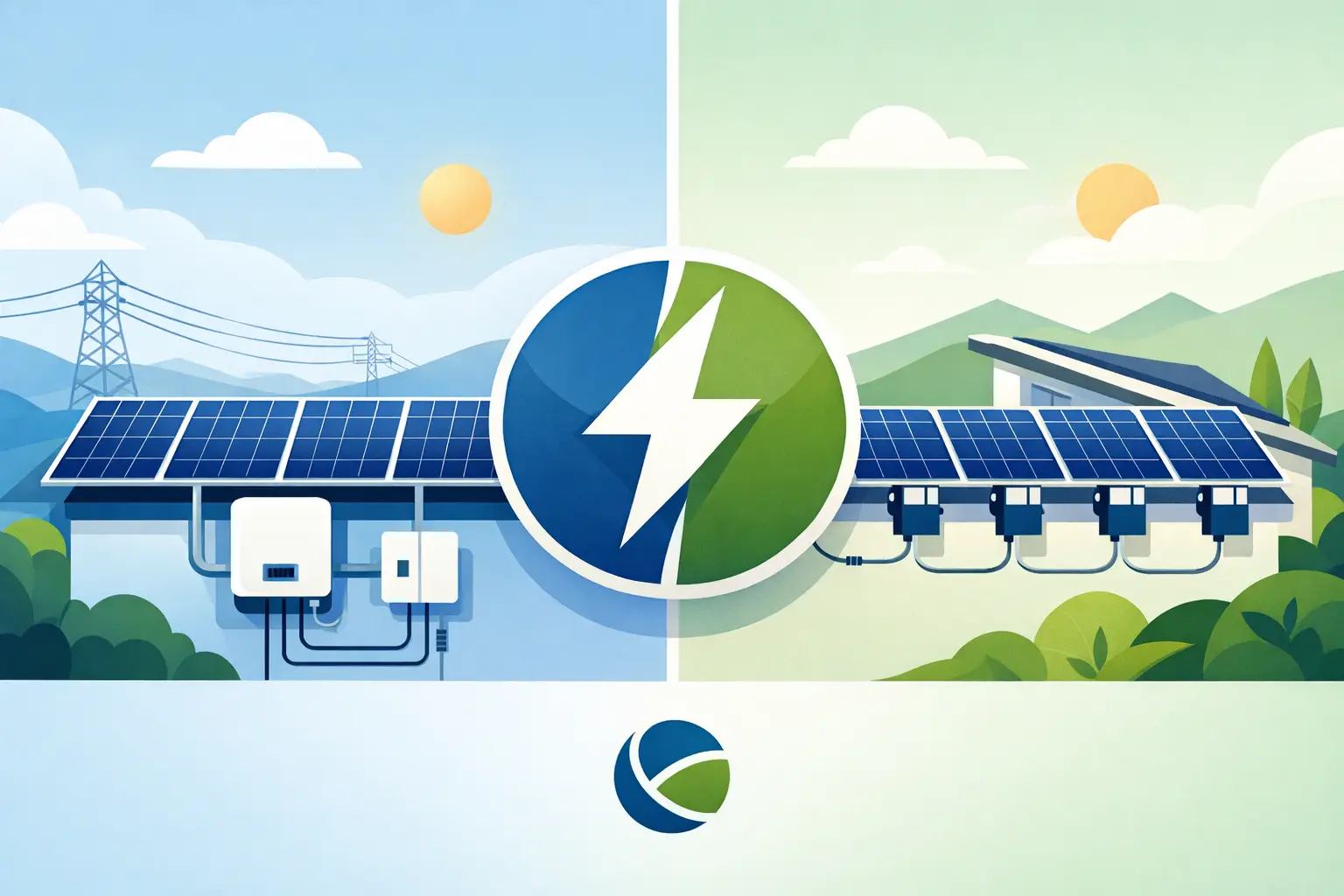
The main difference is where that conversion and control happen. A string inverter is usually installed on a wall near your consumer unit, loft or garage. Microinverters are fitted beneath individual solar panels on the roof.
String inverter vs microinverter: the key difference
A string inverter connects a group of panels together in a series known as a string. The panels share the same operating conditions to an extent, so the output of the string can be affected if one panel is significantly shaded, dirty or performing differently from the rest.
With microinverters, each panel has its own small inverter. Every panel converts its own DC electricity to AC at roof level and operates more independently. If one panel is shaded, the remaining panels can continue producing according to the sunlight they receive.
That independent operation is the reason microinverters are often recommended for complex or shaded roofs. It is also why they usually cost more upfront.
When a string inverter is the sensible choice
A string inverter is the established choice for many residential and commercial systems. On a straightforward, south-facing roof with little or no regular shade, it can provide excellent generation at a lower installation cost.
This setup is particularly effective when panels can be grouped by the same orientation and pitch. For example, a clean row of panels on one unshaded roof plane is well suited to a string inverter. Modern string inverters are efficient, reliable and available with detailed system monitoring.
They can also be practical from a maintenance perspective. Because the main inverter is installed at ground level or in an accessible area, an engineer can inspect or replace it without needing roof access. Inverters do not last forever, so that accessibility can matter over the lifetime of the system.
For a larger commercial roof with long, uniform panel rows, string inverters can be a cost-effective way to deliver strong output. Multiple strings and multiple maximum power point trackers can accommodate sections of a roof that face different directions, provided the system has been properly designed.
The trade-off is that a string arrangement needs careful planning around shade. A chimney, neighbouring tree, dormer or even seasonal shading can affect a panel at particular times of day. If that panel sits in a string, it may restrict the performance of the wider group.
When microinverters are worth the extra cost
Microinverters can make a real difference where a roof is broken into several areas, has multiple orientations or receives inconsistent shade. A typical example is a house with panels spread across east-, west- and south-facing roof sections, with a chimney casting a moving shadow during part of the day.
Because each panel works independently, microinverters reduce the impact of panel mismatch. This does not create electricity from nowhere – a shaded panel will still generate less – but it prevents that panel from holding back the rest of the array to the same degree.
They are also attractive for homeowners who want panel-level monitoring. Instead of seeing the production of an entire string, you can see how individual panels are performing. That can be reassuring on a more complicated roof and can make it easier to identify a fault or unusual drop in output.
Microinverters are naturally modular. If you expect to add a few panels later, an AC-coupled design can be easier to expand, subject to roof space, equipment compatibility and electricity network approval. They can also suit small solar arrays where creating an efficient string is difficult.
The main consideration is price. You are buying more electronic equipment and each unit is mounted beneath a panel. Although quality microinverter systems are designed for roof-level use and commonly come with long product warranties, a future fault may require an engineer to access the roof and temporarily remove a panel.
What about solar optimisers?
Optimisers are often mentioned in the same conversation, but they are not the same as microinverters. An optimiser is fitted to each panel and improves the way that panel works within a string. The DC electricity still travels to a central string inverter for conversion to AC.
This can be a useful middle ground. Optimisers can provide panel-level visibility and improve performance where partial shade or mixed roof conditions are a concern, while retaining an accessible central inverter. They do add cost and roof-mounted components, so they should be specified to solve a genuine design issue rather than added by default.
A good survey should assess whether shade is substantial and recurring, not simply whether a roof has a chimney. The timing, duration and position of shade matter just as much as its presence.
Battery storage changes the conversation
If you are considering a home battery, ask how it will work with the proposed inverter architecture. A hybrid string inverter can manage solar panels and a compatible battery through a single integrated system. This is often a neat and efficient option for a new installation.
Microinverter arrays produce AC electricity at the roof, so batteries are commonly added as AC-coupled systems. This can offer flexibility, especially when adding storage to an existing solar installation, but the energy passes through additional conversion stages in some situations. The difference in real-world performance depends on the equipment and how the household uses its energy.
Battery choice should not be driven by inverter type alone. Your typical daytime consumption, overnight use, tariff, electric vehicle charging and any plans for a heat pump all influence the right battery capacity and control strategy. A well-sized system should prioritise using your solar generation intelligently, rather than chasing the largest battery possible.
Costs, warranties and lifetime value
Microinverters generally have a higher upfront cost than a conventional string inverter. For a simple roof, the additional generation may not be enough to justify that premium. In that case, placing more of the budget into extra panel capacity or battery storage could deliver greater value.
On a shaded or multi-directional roof, the calculation can change. Better output across the day may improve self-consumption, particularly for households that are at home during daylight hours or use timed appliances, an electric vehicle charger or battery storage.
Warranty terms deserve a close look as well. Microinverters often offer long warranties because they are intended to remain in place for many years. Central string inverter warranties may be shorter, though extensions are sometimes available. The more useful question is not simply the headline warranty length, but who will diagnose the issue, arrange access, manage a replacement and support you after installation.
How to choose the right inverter for your roof
The best decision follows a proper site survey and system design. Your installer should consider roof orientation and pitch, usable roof area, shading across the year, current electricity use, future demand and the condition of the roof itself. They should also explain projected generation in plain terms and show why a particular inverter setup has been selected.
For an unshaded, uncomplicated roof, a string inverter will often be the practical, value-led recommendation. For a roof with several aspects, frequent partial shade or an awkward layout, microinverters or optimisers may protect more of the array’s output. For commercial properties, the decision may involve array size, roof zoning, maintenance access and operational demand as well as shading.
Avoid choosing solely on a claim that one technology is always superior. A high-quality system is one where every component works together: panels, inverter, mounting, electrical protection, monitoring and, if required, battery storage. MCS-certified design and installation are just as important as the equipment selected.
A clear proposal should leave you confident about what your system will produce, how you will monitor it and what support is available if you need help. That is how a solar installation becomes a dependable way to own more of your energy, year after year.