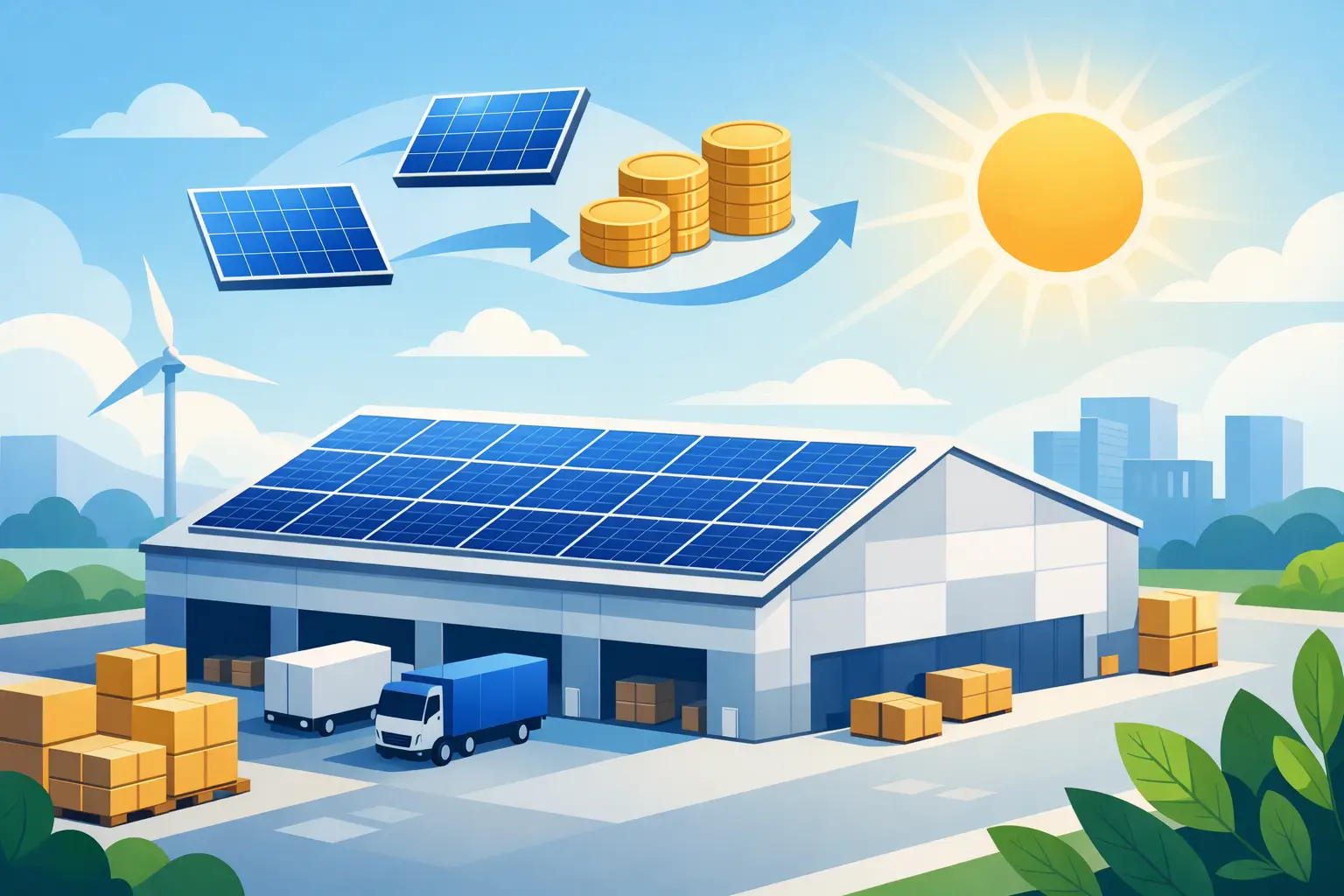
A warehouse roof can sit unused for decades while the building beneath it consumes expensive electricity every working day. For businesses running lighting, heating, refrigeration, equipment, offices or electric vehicle charging, solar panels for warehouses turn that overlooked space into a practical source of power – and greater control over operating costs.
The strongest business case is not based on producing as much energy as possible. It is based on producing electricity when your business needs it most. A professionally designed commercial system should match the building’s roof, energy profile and future plans, so more of the power generated is used on site rather than exported at a lower rate.
Why warehouse roofs are well suited to solar
Warehouses often have the qualities solar installers look for: broad roof areas, relatively low levels of shading and meaningful daytime electricity demand. Even where a business does not operate around the clock, demand from lighting, machinery, IT systems and staff facilities can make solar generation highly valuable during normal working hours.
A large roof does not automatically mean a system should cover every available square metre. The right system size depends on half-hourly consumption data, roof orientation, structural capacity, lease arrangements and the available grid connection. Oversizing a system can still make sense in some cases, particularly where export payments, battery storage or future electrification are part of the plan. But it should be a deliberate commercial decision, not an assumption.
For owner-occupiers, the attraction is clear: a warehouse can become a long-term energy asset while the business continues to operate as usual. For landlords, solar can also help make industrial space more appealing to tenants facing rising energy costs and sustainability targets. The detail matters, however. Lease terms, responsibility for electricity bills and access for maintenance should be agreed before a project moves forward.
How solar panels for warehouses reduce costs
Every kilowatt-hour generated and used within the warehouse avoids buying that electricity from the grid. This is known as self-consumption, and it is usually where the greatest financial value lies. The more of your generation used on site, the more directly solar can reduce electricity costs.
A warehouse’s pattern of demand matters as much as its annual bill. A business with steady daytime consumption is normally well placed to use solar power as it is generated. By contrast, a site that uses most of its electricity overnight may benefit from a different system design, potentially including battery storage or a smaller array focused on its daytime base load.
Solar does not remove the need for a grid supply. Generation changes with the seasons, weather and daylight hours. Instead, it reduces the volume of electricity bought at peak-value times and gives a business more protection from future price volatility. That predictability can be particularly useful when margins are tight and energy is a significant overhead.
The value of using power on site
Exporting surplus electricity can create an additional income stream, but export rates are typically lower than the price of electricity a business would otherwise buy. This is why accurate design is so important. The aim is to achieve a sensible balance between generation, on-site use and export.
A good proposal should show expected annual generation, likely self-consumption, estimated export and the assumptions behind projected savings. It should also explain how the figures could change if operating hours, occupancy or equipment use changes. Clear modelling is more useful than a headline saving that cannot be tested.
Start with the building, not the panels
The first question is whether the roof is ready. Before system design, a competent installer should assess its age, condition, construction and capacity to support the proposed array. A roof that is nearing the end of its life may need repairs or replacement before solar is installed. Addressing that early can prevent the cost and disruption of removing panels later.
Roof access, drainage routes, rooflights, smoke vents and existing plant all need consideration. So do fire safety requirements and safe routes for future inspection and maintenance. On a busy logistics or manufacturing site, installation planning must also account for vehicle movements, loading areas and the need to keep operations running safely.
Planning requirements vary by location and building type. Listed buildings, conservation areas and particular site constraints may need additional checks. Grid connection is equally important. Your local Distribution Network Operator must assess larger installations and confirm what can be connected or exported. In some cases, network limitations influence the viable system size or require export controls.
This early work is not bureaucracy for its own sake. It protects the return on investment by making sure the finished system can perform as intended.
Battery storage: useful, but not always essential
Battery storage can retain solar electricity generated during the day for use later, helping a warehouse increase its self-consumption. It can be valuable where afternoon or evening demand is high, where the site is adding electric vehicle chargers, or where a business wants more flexibility in how it uses energy.
That said, batteries are not automatically the right first step. If a warehouse already uses most of its solar generation during the day, the additional savings may not justify the extra capital cost immediately. A sensible approach is to design the solar system with future battery integration in mind, then make the decision using actual consumption and generation data after installation.
For sites with critical loads, battery systems may also be considered as part of a wider resilience strategy. However, not every battery provides backup power during an outage. Backup capability requires the right equipment, system design and safety arrangements. It should never be assumed from the presence of a battery alone.
What a credible warehouse solar proposal should include
Commercial solar is a long-term investment, so a proposal should make it easy to understand both the opportunity and the obligations. It should include a site-specific design rather than a generic panel count, along with expected annual generation and a transparent savings calculation.
It should also set out the equipment warranties, workmanship cover, monitoring arrangements and maintenance expectations. Commercial roofs are working assets, and solar should be treated in the same way. Remote monitoring can flag unusual performance, while planned inspections help identify issues such as debris, shading changes or electrical faults before they affect output significantly.
Ask how installation will be organised around your operation. A warehouse cannot always pause dispatches or close access routes. The contractor should explain the programme, safety controls, lifting arrangements and any periods when electrical works may affect the site. Clear communication before work begins is often the difference between a smooth installation and an avoidable operational headache.
At Infused Solar Energy, that end-to-end approach starts with understanding the site and its energy use, then carrying the project through design, installation, monitoring and aftercare. For commercial decision-makers, one accountable team makes it easier to keep the technical, financial and practical details aligned.
Looking beyond the first year of savings
The best case for warehouse solar is usually built over years, not months. Electricity tariffs can change, business activity can grow and a site may later add new loads such as heat pumps, electric forklifts or vehicle charging. A system designed with realistic headroom and a clear view of future demand can remain useful as the business changes.
There are trade-offs. A larger array may produce more energy, but not all of it may be used on site. A battery can increase flexibility, but adds cost. A roof renewal can delay a project, but may be the wiser choice than fitting panels to a surface that will soon need major work. Honest advice should make these decisions clearer, not hide them behind optimistic payback figures.
A warehouse roof is more than a weatherproof covering. With the right survey, system design and long-term support, it can help your business buy less electricity, plan with more confidence and make better use of an asset it already owns.