A brand-new home should not leave you watching your electricity bill climb from the first winter. Yet buyers are often told a property is “energy efficient” without a clear explanation of whether it has solar panels, how much power they produce, or what can be added later. Understanding new build solar requirements helps you ask the right questions before you exchange contracts: and make a smarter long-term investment in your home.
Are solar panels required on new builds in the UK?
There is no single rule that says every new home across the UK must have solar panels. Building regulations and planning policy vary between England, Wales, Scotland and Northern Ireland, while individual local authorities can also set planning conditions that affect renewable energy measures.
What developers must do is ensure a new dwelling meets the applicable energy-efficiency and carbon-emissions standards. Solar PV is one of the most practical ways to achieve those targets, particularly when combined with good insulation, efficient heating and low-energy lighting. That is why solar is becoming increasingly common on new housing developments, even where it is not a direct legal requirement.
For buyers, the key distinction is simple: a home may be designed to meet regulations without solar, but solar can help it perform better in real life. It can reduce the electricity you buy from the grid, improve your control over household energy use and prepare the property for electric vehicle charging or a future battery.
What new build solar requirements mean in practice
The phrase “solar ready” is often used in sales literature, but it can mean different things. In some cases, it means the roof has been assessed as suitable for panels. In others, the developer may have allowed space in the consumer unit or installed cable routes for a future system. Neither necessarily means panels are included.
If a property is being sold with solar, ask for confirmation of the system size in kilowatts peak (kWp), the estimated annual generation, the panel and inverter specifications, and who owns the equipment. You should also receive the relevant handover information, warranties and details of how monitoring is accessed.
A small system can still be worthwhile, particularly for a household with lower daytime usage. However, a system designed only to satisfy a development’s compliance calculation may not be the best fit for your family’s needs. A larger roof area, an electric car, home working, a heat pump or plans for battery storage can all justify a more considered design.
Building regulations are not the same as a solar design
Compliance calculations work from assumptions about the property. Your actual savings depend on how you live there. A household that uses most of its electricity in the evening will benefit differently from solar than one where somebody works from home and runs appliances during the day.
This is where a bespoke approach matters. The right system considers roof orientation, shading from nearby buildings or trees, usable roof space and your expected electricity demand. It should also consider whether a battery makes financial sense now or whether the system should simply be designed to make a later battery upgrade straightforward.
Questions to ask your developer before you buy
Solar is most cost-effective when it is planned into a home from the start. Before reserving a new-build property, ask the developer whether solar PV is included as standard, optional or not available. If it is included, establish exactly what you are getting rather than relying on a brochure image.
You should ask whether the system has been registered correctly, whether you will receive an MCS certificate where applicable, and whether the installer will provide commissioning documents and manufacturer warranties. These records matter if you want to join the Smart Export Guarantee and receive payment for surplus electricity exported to the grid.
It is also sensible to ask whether the roof has capacity for additional panels. A development may fit a modest array, but a larger system could be possible once the home is yours. If the property is leasehold, or subject to estate management rules, check whether you need permission for later changes to the roof.
Finally, ask about the electricity meter and export arrangements. Solar systems need the right metering setup for accurate import and export readings. A clear handover avoids the common frustration of owning panels but not being able to see what they are generating or receive export payments promptly.
Should you add a battery to a new-build solar system?
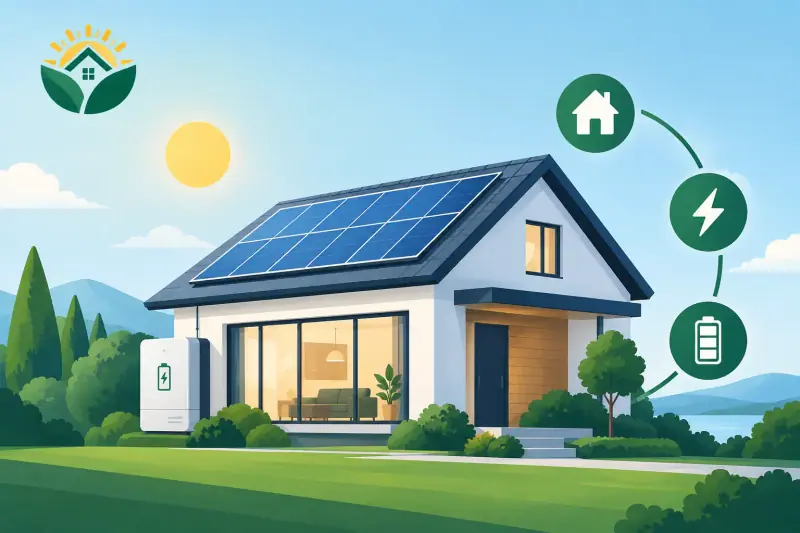
A battery is not normally part of new build solar requirements, but it can be a valuable addition. Solar panels generate most power during daylight hours, while many households use more electricity in the morning and evening. A battery stores unused daytime generation so that more of it can be used later at home.
Whether it is right for you depends on your usage pattern, tariff and budget. A battery can increase solar self-consumption and help you make better use of off-peak electricity tariffs. It does add upfront cost, though, so it should be sized around realistic consumption rather than chosen simply because it is available.
For some buyers, the sensible route is to move in, review a few months of electricity data and then add storage. For others, especially households expecting to charge an EV, install a heat pump or use high levels of evening electricity, installing a battery from day one can make more sense. A system designed with expansion in mind keeps both options open.
Do planning rules affect solar panels on a new build?
Many domestic solar installations can be installed under permitted development rules, but there are exceptions. Listed buildings, conservation areas, flats, unusual roof designs and local planning conditions can all change what is possible. New estates may also have covenants or management-company rules that affect external alterations.
This does not automatically prevent solar. It means the checks need to happen before installation, not after panels have been ordered. A professional survey should identify roof suitability, access requirements, shading, electrical capacity and any permissions that may be needed.
For commercial new builds, the conversation is often broader. Roof-mounted solar may be considered alongside energy demand, operating hours, landlord responsibilities and future expansion. A warehouse with substantial daytime consumption may gain far more from a well-sized array than from a minimum-compliance installation. The same principle applies: the best system is built around how the building will actually be used.
Why installer choice still matters on a new build
A solar system is not just panels on a roof. The quality of the design, roof fixings, electrical work, commissioning and aftercare has a direct effect on performance and peace of mind. A low-cost specification may look attractive at handover, but it can create avoidable limitations when you want to add a battery, EV charger or more panels later.
Look for clear proposals, realistic generation estimates and an installer that explains the equipment in plain English. MCS-certified engineers, insurance-backed workmanship and proper monitoring setup provide useful reassurance. You should know who to contact if you have a question after moving in, not just on installation day.
At Infused Solar Energy, we take an end-to-end view of solar: from site survey and system design through to installation, monitoring and ongoing support. That matters for new-build owners because the system should support the way you plan to live, not merely tick a compliance box.
Make your new home work harder from day one
New build solar requirements are pushing housing in the right direction, but minimum standards are only the starting point. Before you commit to a property, understand what is installed, what it can generate and whether it can grow with your needs. A well-designed solar and battery system can turn an efficient new house into a home that gives you more control over your energy for years to come.