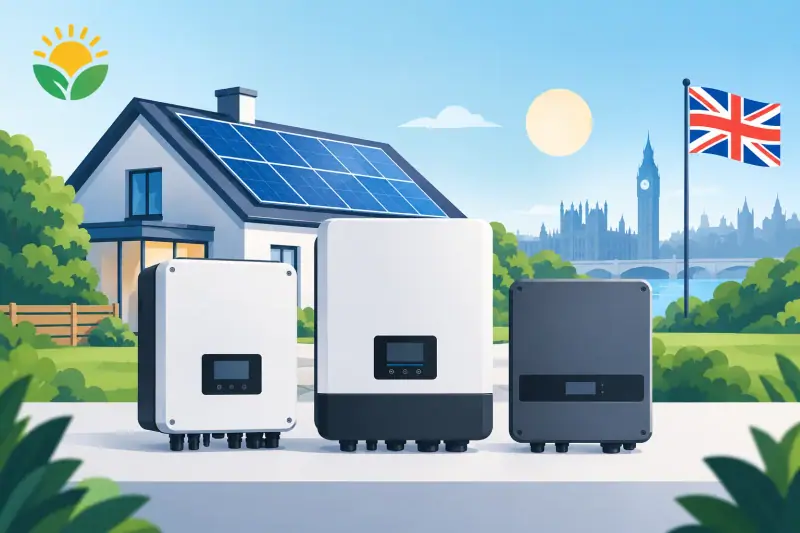
A solar inverter may be a relatively small part of your installation, but it has a major influence on how much useful electricity your panels produce. This solar inverter review UK is designed to cut through brand noise and focus on the questions that genuinely affect your bills, battery options and long-term peace of mind.
The right answer is rarely simply the inverter with the highest headline efficiency. Your roof layout, the number of panels, shading, planned battery storage and electricity habits all matter. A well-matched inverter, professionally installed and correctly configured, will generally deliver better value than an expensive model selected in isolation.
What a solar inverter does for your home
Solar panels produce direct current electricity, while your home and the National Grid use alternating current. The inverter converts that solar generation into power your home can use for appliances, lighting and charging a battery. It also manages how energy is exported when your system is producing more than the property needs.
Modern inverters do more than conversion. They monitor generation, communicate with batteries and, in some cases, work with smart tariffs, electric vehicle chargers and export controls. This is why the inverter should be considered during the full system design, rather than as a last-minute component choice.
For most homes, a string inverter is the standard option. Panels are connected in groups, known as strings, and their output is processed by one central inverter. It is cost-effective, reliable and a very good fit for an uncomplicated roof with limited shading.
Microinverters are fitted at, or close to, individual panels. They can be especially useful where roofs face several directions or where chimneys, trees and dormers create regular shade. They tend to cost more, but can improve output where a conventional string system would be held back by weaker-performing panels.
Solar inverter review UK: the features worth comparing
It is tempting to compare only the advertised conversion efficiency. Most quality residential inverters now operate at very high efficiency, so a small percentage difference is unlikely to outweigh poor system sizing or unsuitable panel layout. Instead, look at the wider picture.
Power rating and sensible sizing
An inverter must be sized to suit the array and the property. A 4kW inverter may be appropriate for many typical domestic systems, but it is not automatically right for every home. Oversizing or undersizing can affect performance at different times of year and can influence future expansion plans.
Installers may recommend an inverter with a lower AC rating than the combined panel capacity. This is not necessarily a concern. Panels rarely achieve their full stated output under typical UK conditions, and a modest degree of oversizing can make good financial sense. The important point is that the design is explained clearly, including any expected clipping during bright conditions.
Battery compatibility
If you want battery storage now, or think you may add it later, this should shape your choice from day one. A hybrid inverter can manage panels and a compatible battery through one unit. It can be neat, efficient and easier to monitor, although it may tie you to a narrower range of battery products.
An AC-coupled battery can be added to many existing solar systems, including those with a standard string inverter. This can offer flexibility for future upgrades, but involves an additional conversion stage. Neither approach is universally better. The best option depends on whether battery storage is central to your plans today or a possible future improvement.
Monitoring you will actually use
Good monitoring helps you understand whether you are using solar electricity at the right times. Most inverter manufacturers provide an app showing generation, consumption and export, although the level of detail varies. Where a system includes battery storage, the app should make it clear when the battery is charging from solar, powering the home or charging at cheaper overnight tariff rates.
A clear monitoring platform is valuable, but it should not be the deciding factor alone. It is also worth asking how system access will work after installation, whether the homeowner has full account ownership and what support is available if the app or internet connection changes.
Warranty and support
Inverter warranties commonly range from five to 12 years, with extensions available on some products. A longer warranty can be reassuring, but it is only one part of the story. Consider the manufacturer’s UK support arrangements, the installer’s workmanship cover and how a fault would be diagnosed and resolved.
At Infused Solar Energy, system design is supported by professional installation, monitoring set-up and ongoing aftercare. For a homeowner, that means one clear point of contact rather than being left to interpret error codes or chase several suppliers.
How leading inverter approaches compare
There is no single best inverter brand for every UK property. However, the main approaches are useful to understand before reviewing quotations.
SolarEdge is known for its optimiser-based design. Each panel uses an optimiser, allowing panel-level monitoring and helping reduce the effect of shading or mismatched roof orientations. It can be a strong option for more complex roofs, though the equipment cost is usually higher than a straightforward string inverter system.
Enphase uses microinverters, with conversion taking place at each panel. This approach is well suited to roofs with several orientations, partial shading or future expansion in mind. It also avoids having a single rooftop string inverter, but it is usually among the more premium options and should be justified by the roof conditions.
Huawei, Solis, Fox ESS and GivEnergy are frequently considered for domestic systems, particularly where value, hybrid capability and battery integration are priorities. Specific compatibility differs between models, so the key question is not whether a brand is popular. It is whether the proposed inverter works properly with the battery, panel configuration and energy goals in your quote.
For commercial properties, inverter selection becomes even more site-specific. Three-phase supply, larger arrays, export limits, roof sections and load patterns can all affect the recommended equipment. A warehouse that uses electricity through the working day has different priorities from an office that is largely empty at weekends.
When a cheaper inverter can cost more
The lowest-priced inverter may be perfectly suitable for a simple, unshaded roof where no battery is planned. Paying for complex panel-level technology in that situation may not improve returns enough to justify the additional spend.
However, choosing the cheapest option without considering shade, future storage or local support can create false economy. If one shaded panel regularly limits a whole string, or if adding a battery later requires replacing major equipment, the initial saving can disappear. The strongest proposal will explain these trade-offs in plain English rather than treating every home as identical.
Also consider the practical installation details. The inverter needs a suitable location with ventilation, accessible cabling and reliable connectivity if monitoring is required. A garage or utility area is often ideal, but every property is different. Noise is usually modest, though a faint operational hum can be noticeable in a quiet living space.
Questions to ask before accepting a quote
Ask your installer why that inverter model has been selected for your roof, rather than simply requesting a particular brand. You should receive a clear answer covering panel orientation, shading, array size and anticipated annual generation.
Ask whether the inverter is battery-ready, which batteries it supports and what would be involved in adding storage later. If backup power matters to you, ask specifically about backup capability. A battery alone does not guarantee that your home will continue running during a power cut. Backup circuits, changeover equipment and system design are all required.
Finally, check that the proposal explains warranties, monitoring ownership, workmanship cover and the process for support. An MCS-certified installation and properly managed grid connection process help protect both system performance and your ability to access available export payments.
Choose the system, not just the specification sheet
A solar inverter should help you use more of your own electricity, not become another technical decision to worry about. The best choice is the one that suits your roof today, supports your plans for battery storage or an electric vehicle tomorrow, and is backed by installers who will still answer the phone after commissioning.
Before making a decision, ask for a design that shows how the proposed inverter fits into your complete energy system. When the reasoning is clear, owning more of your energy becomes a practical, confident investment rather than a leap of faith.