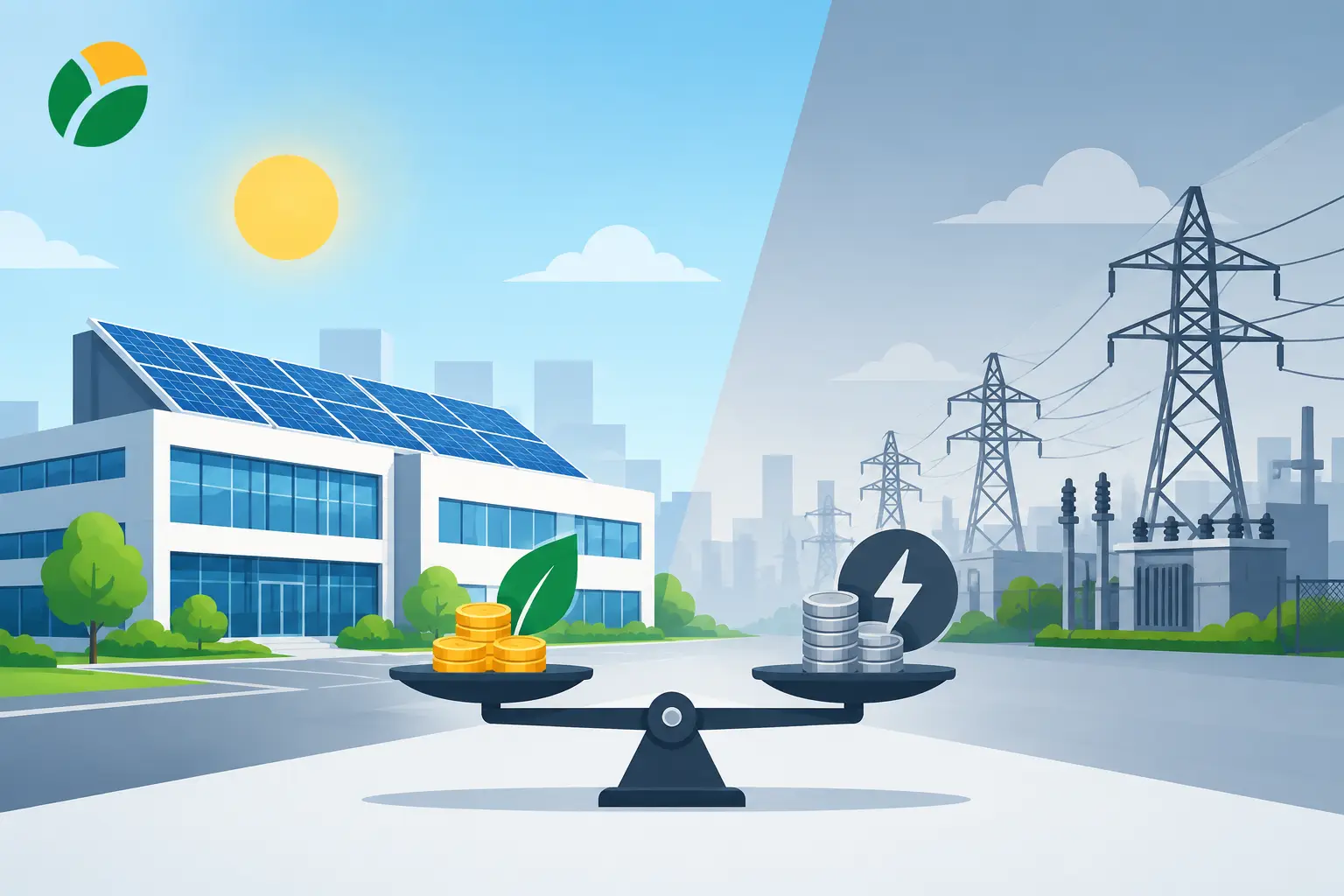
A business using most of its electricity during daylight hours is often paying the grid at precisely the time a well-designed solar system could be producing power on site. That is the central question in commercial solar vs grid electricity: not whether solar can generate energy, but how much of that generation your business can use, what it replaces, and whether the investment suits your premises and operating plans.
For many UK businesses, grid electricity remains essential. Solar does not mean disconnecting from the network, and it will not eliminate standing charges or every electricity bill. It can, however, reduce the amount of imported electricity your site needs to buy, giving you greater control over a cost that has become increasingly difficult to predict.
Commercial solar vs grid electricity: what are you paying for?
Grid electricity is convenient because it is available whenever your business needs it. You pay for the units you import, usually alongside standing charges, network costs and supplier margins within your tariff. The challenge is that these costs can change at renewal, making budgets harder to forecast.
Commercial solar turns suitable roof or land space into a source of electricity. Once the system is installed, every unit generated and used on site is a unit you do not need to purchase from the grid at your normal import rate. The system has an upfront cost, but its fuel source is sunlight rather than a supplier contract.
This is why comparing the two is not simply a matter of looking at a solar quote beside one month’s bill. A useful comparison considers your current unit rate, annual consumption, half-hourly usage pattern where available, future energy needs and the likely lifetime of the building. Solar is a long-term asset, while grid electricity is an ongoing operating expense.
The value of using power as it is generated
The strongest commercial solar cases are usually built around self-consumption. This means using solar electricity in your premises at the point it is generated, for lighting, refrigeration, machinery, office equipment, ventilation or electric vehicle charging.
If your site is active through the middle of the day, solar production may align well with demand. A warehouse with daytime operations, a school, a retail site, a care setting or an office with regular weekday occupancy can often make practical use of the power its panels generate.
Exporting surplus electricity can provide an additional return, but it is generally less valuable than avoiding an imported unit of electricity. Export rates vary by supplier and tariff, so a sensible commercial proposal should not rely on optimistic export assumptions to make the figures work.
A quieter building with high weekend or evening use may still be suitable, but the system size and expected savings need more careful consideration. Installing more panels than the business can use is not always the best financial decision. Good design starts with consumption, not just available roof area.
Upfront investment versus ongoing grid costs
Grid electricity has no installation cost, but it never becomes an owned asset. Your business continues to buy the energy it consumes, with costs influenced by wholesale markets, contracts and wider network charges.
Solar requires capital investment or an agreed finance route. In return, it can deliver lower imported electricity costs over many years. Payback periods vary considerably, which is why generic promises should be treated cautiously. The outcome depends on the system cost, electricity price, solar generation, self-consumption level, roof complexity and whether battery storage is included.
For a business owner, the more useful question is often: how much of our annual electricity spend can we reasonably offset, and over what period? A clear proposal should show estimated annual generation, likely on-site use, expected export and projected savings based on transparent assumptions.
It should also distinguish between forecasts and guarantees. Solar output is affected by weather, panel orientation, shading and system performance. An experienced installer will model these factors rather than presenting a headline figure without context.
Reliability, resilience and the role of the grid
Commercial solar is dependable in the sense that panels have no moving parts and require relatively little day-to-day attention. They generate electricity whenever there is daylight, although output naturally changes with the season and weather. Summer production is often much higher than winter production.
The grid remains the dependable back-up source when solar output is lower than your demand, including overnight. For most businesses, the practical model is solar working alongside the grid, not replacing it entirely.
Battery storage can change that relationship. A commercial battery can store some unused solar generation for later use, helping a business use more of its own energy. Depending on the system and tariff, it may also support load shifting by charging at lower-cost times and reducing imports during more expensive periods.
However, batteries are not automatically right for every site. They add cost and should be sized around a clear need, such as evening demand, high peak usage, a desire to improve solar self-consumption or operational resilience. Backup power during an outage also requires specific equipment and system design. A standard solar installation should not be assumed to keep a building powered during a grid failure.
Your roof, lease and future plans matter
Before comparing commercial solar with grid electricity on price alone, assess whether the property can support the project. Roof condition, structural suitability, orientation, shading, access and available electrical capacity all affect feasibility and cost.
Businesses occupying leased premises should check lease terms and secure landlord consent early. If you plan to move within a few years, the decision may need a different financial approach than for a long-term owner-occupied site. Solar can add value to a property and strengthen its sustainability credentials, but the benefits must fit your ownership and occupancy plans.
For larger installations, the local Distribution Network Operator may need to approve the connection or export capacity. This is a normal part of project planning, but it can influence system design and timescales. It is far better to identify these requirements before committing to a particular array size.
Carbon reporting and customer expectations
The financial case is usually the first priority, but solar can support wider business goals too. Generating renewable electricity on site can reduce the carbon impact associated with purchased power and provide a clear, measurable sustainability action for staff, customers and supply-chain partners.
That matters particularly for businesses responding to tender requirements, corporate reporting requests or customer expectations around environmental responsibility. The strongest message is an honest one: solar reduces reliance on grid imports and supports lower-carbon operations, but it should sit within a broader plan for efficient lighting, heating, equipment and energy management.
How to make the comparison properly
A worthwhile assessment begins with at least 12 months of electricity bills, ideally supported by half-hourly data for larger sites. This reveals when your business uses energy, not merely how much it uses in a year. It also helps identify seasonal changes, overnight loads and periods of peak demand.
From there, a tailored design can model a system that matches your roof and usage profile. Ask for a clear explanation of panel layout, inverter choice, anticipated generation, estimated self-consumption, export assumptions, maintenance expectations and warranties. You should also understand what is included in monitoring, electrical works, grid applications and aftercare.
MCS-certified installation matters for quality and process, while proper system monitoring gives your team visibility after commissioning. Solar should not be a fit-and-forget purchase. Regular monitoring helps confirm that the system is performing as expected and highlights faults before they become prolonged periods of lost generation.
The better question for your business
Commercial solar is not automatically cheaper than grid electricity in every circumstance. A heavily shaded roof, low daytime demand, a short lease or a building nearing major refurbishment may mean waiting or taking a different approach. Equally, a business with stable daytime consumption and a suitable roof may have a compelling opportunity to reduce imported power for decades.
The goal is not to choose solar or the grid as though they are competing utilities. It is to use solar intelligently, reduce the electricity you need to buy, and retain the grid where it adds value. With a site survey, honest modelling and a system designed around how your business actually operates, you can decide whether owning more of your energy is the right next move.