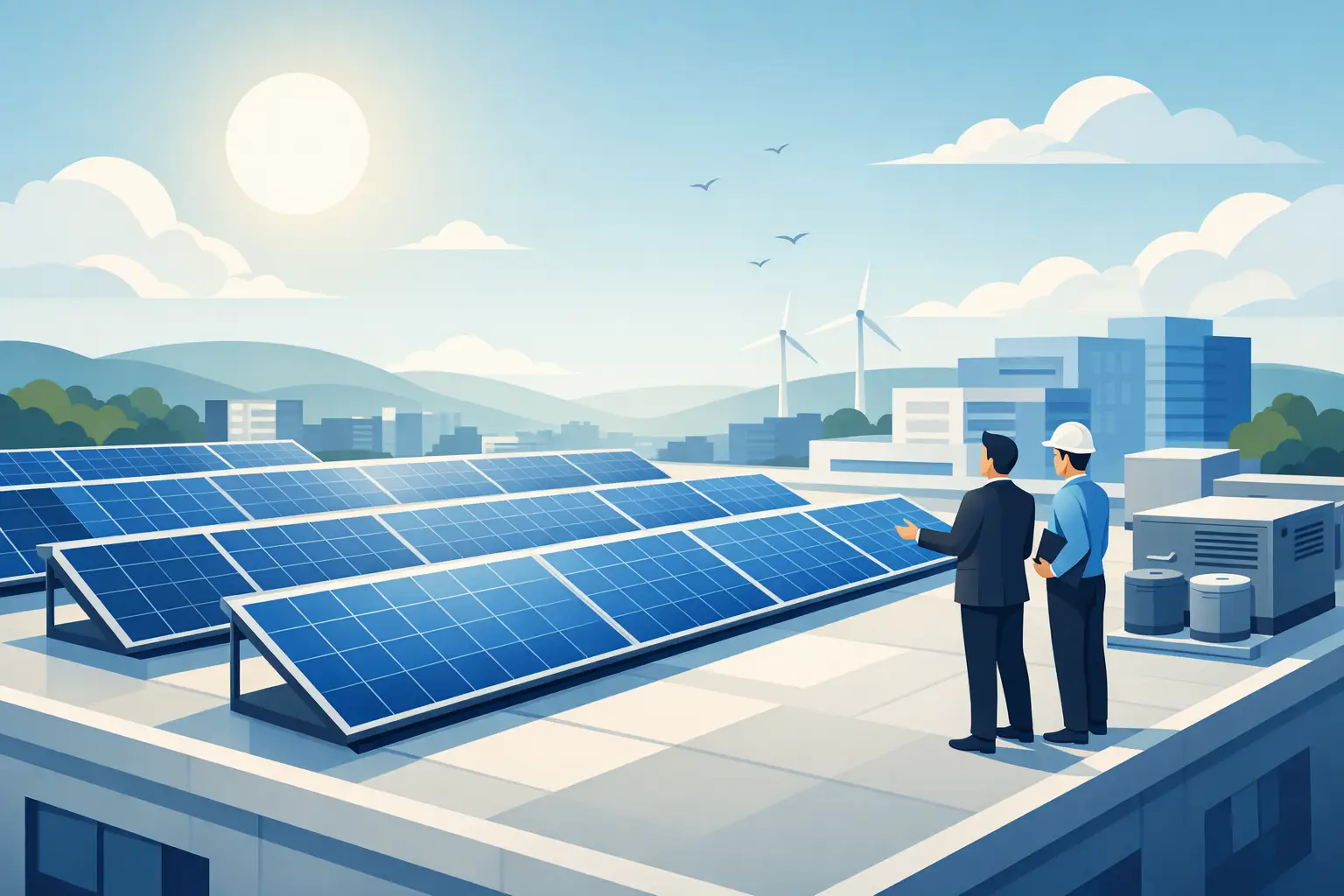
A commercial roof can be one of the most valuable assets your business owns. While it is often overlooked, it may be producing clean electricity for your premises for the next 25 years or more. This commercial rooftop solar guide explains what UK businesses should assess before committing, from roof suitability and system sizing to savings, approvals and long-term support.
For many organisations, the strongest case for solar is simple: electricity generated and used on site can reduce the amount of power bought from the grid. The right system gives your business more control over an unpredictable operating cost, while demonstrating a practical commitment to lower-carbon operations.
Start with your electricity use, not the number of panels
The best commercial solar systems are designed around how a building uses energy. A large roof does not automatically mean that the largest possible array is the best investment.
Begin by reviewing at least 12 months of half-hourly or monthly electricity data. This shows your annual consumption, seasonal changes and, crucially, when your business uses the most power. A warehouse operating mainly during daylight hours may use a high proportion of solar generation directly. A site with significant evening demand may still benefit from solar, but could achieve more value by considering battery storage or adjusting certain loads to daytime hours.
Your business plans matter too. New machinery, EV charging points, extended operating hours or a planned expansion can all change the right system size. Equally, if a tenant is due to leave or the building may be sold, the financial model needs to reflect that reality.
The aim is not to promise a single savings figure before the facts are known. It is to create a tailored design that balances generation, on-site consumption, export potential and capital spend.
What makes a commercial roof suitable for solar?
A professional site survey is where assumptions become an installation plan. Surveyors will assess the roof construction, orientation, pitch, available area, shading and safe access. South-facing roofs are often productive, but east-west arrays can be an excellent choice for businesses with demand spread across the morning and afternoon.
Flat roofs are commonly well suited to commercial solar. Panels can be mounted on purpose-designed frames at a low angle, with spacing that limits shading between rows. The layout must account for wind loading, roof drainage, rooflights, plant equipment and access routes for future maintenance.
Structural capacity and roof condition
The roof must be able to support the proposed system, including panels, mounting equipment and any ballasting required. A structural assessment may be needed, particularly on older buildings or roofs with lightweight construction. It is much better to identify restrictions early than redesign the project after equipment has been ordered.
Roof condition matters just as much. If a roof covering is approaching the end of its life, it is often sensible to repair or replace it before solar is installed. Removing and reinstalling panels later is possible, but adds avoidable cost and disruption.
Asbestos also needs careful management. Where asbestos-containing materials may be present, appropriate surveys and a safe, compliant plan are essential before any work begins.
Ownership, leases and permissions
If you own the building outright, the process is usually more straightforward. Tenants, managing agents and businesses on leased premises should establish who owns the roof and obtain written consent before progressing. Lease terms, dilapidation obligations and insurance requirements can affect what is possible.
Many commercial rooftop installations can be developed under permitted development rights, but this is not guaranteed. Listed buildings, conservation areas, planning conditions and local restrictions can change the position. A careful installer will review the project requirements rather than treating planning as an afterthought.
Commercial rooftop solar guide: from survey to switch-on
A well-managed project should feel clear from the first conversation. At Infused Solar Energy, the focus is on an end-to-end process that gives decision-makers the information they need without leaving them to coordinate multiple contractors.
The process normally starts with an initial discussion about your premises, annual electricity spend, operating hours and objectives. A site survey then confirms the roof details, cable routes, inverter locations, access arrangements and any electrical upgrades needed.
Your proposal should set out the system size in kWp, expected annual generation in kWh, estimated on-site use, expected export and a clear illustration of predicted savings. Generation estimates are not guarantees: weather, shading, equipment performance and future electricity prices all affect actual results. However, transparent assumptions allow your business to judge the opportunity properly.
Before installation, the design needs to address network approval. Larger systems may require permission from the local Distribution Network Operator before they can be connected. This process can influence the permitted export capacity, project timetable and final design. In some cases, export limitation equipment may allow a system to generate for on-site use while keeping grid exports within an agreed limit.
Installation itself may be completed quickly once planning, network and site arrangements are in place, but commercial projects need sensible coordination. Deliveries, roof access, working hours, parking, welfare facilities and health and safety procedures all need to be agreed around your operations. The goal is to keep disruption low while maintaining safe working standards.
After commissioning, your team should receive the relevant documentation, system handover information and monitoring access. Monitoring is valuable because it allows you to see generation, spot unexpected changes in performance and understand how the system is contributing to your energy strategy.
Understanding savings, payback and export income
Commercial solar economics are driven first by self-consumption. Every unit of solar electricity used directly by your business can reduce the electricity you would otherwise buy, subject to your tariff and charges. Exported electricity may earn income through an export arrangement, but it is usually less valuable than electricity used on site.
That is why two businesses with identical roofs can see very different results. A factory with steady daytime demand may achieve a high self-consumption rate. A building empty during the day may export more power and have a different payback profile.
When evaluating a proposal, ask to see the assumptions behind the figures. These should include anticipated generation, degradation over time, electricity price assumptions, export rate assumptions, maintenance allowances and the proportion of solar expected to be used on site. A credible proposal should make clear what is estimated rather than presenting best-case outcomes as certainty.
Battery storage can be worth considering where solar generation regularly exceeds daytime demand, where evening use is significant, or where your business wants greater resilience and control. It is not automatically right for every commercial site. Batteries add cost, and their value depends on your load profile, tariff structure and operating priorities.
Choose equipment and support for the long term
A solar installation is not simply a panel purchase. It is an electrical system on a working building, expected to perform for decades. The quality of design, installation and aftercare matters as much as the headline price.
Look for a provider that explains the equipment choice, warranty terms and expected maintenance requirements in plain English. MCS-certified engineers, appropriate insurance-backed protections and clear electrical documentation are meaningful signs of professional standards. For qualifying projects, certification can also be relevant when arranging export payments, so confirm the requirements with your chosen energy supplier.
Commercial systems generally need less routine attention than many businesses expect, but they should not be ignored. Periodic visual checks, monitoring reviews and prompt investigation of alerts help protect performance. Cleaning is not automatically necessary in the UK, although it may be worthwhile at sites exposed to unusual dust, bird fouling or industrial residue.
Questions worth asking before you appoint an installer
Ask who will manage the survey, design, network application, installation and commissioning. Confirm whether structural work, electrical upgrades, scaffold or access equipment, and monitoring are included in the quoted price. You should also understand who to contact if performance drops after handover, how quickly support is available, and what warranties apply to both products and workmanship.
A lower upfront quotation is not always the lower-cost decision. A design that overlooks roof repairs, DNO requirements or realistic usage patterns can create delays and reduce returns. The best commercial solar project is one that fits your building, your business hours and your plans for the years ahead.
Your roof may never have been part of your energy strategy before. With the right survey, honest forecasts and experienced installation team, it can become a reliable asset that helps your business own more of its energy and spend less on the power it cannot control.