A home battery is most valuable when it does more than store spare solar power. The best battery backup for home use should lower the electricity you buy from the grid, work with your tariff, and provide the level of protection you expect during a power cut. Those are related benefits, but they are not automatically the same thing.
For many UK households, the right answer is not the battery with the largest headline capacity. It is the system designed around how much electricity you use, when you use it, your existing or planned solar panels, and whether keeping essential appliances running in an outage matters to you.
What makes the best battery backup for home use?
A battery stores electricity in kilowatt-hours (kWh); its power rating in kilowatts (kW) determines how much it can deliver at any one time. Both figures matter. A large battery with a modest power output may run for many hours at low demand, but it might struggle if several high-draw appliances are switched on together.
The best choice is therefore a balance of usable capacity, discharge power, solar compatibility, warranty, intelligent controls and properly designed backup provision. It should also be installed in a sensible location with safe clearances, appropriate protection equipment and a system design that meets current grid requirements.
For a typical home with solar panels, a battery between 5kWh and 13.5kWh is often a practical starting point. That does not mean every household should choose within that range. A smaller property with modest evening use may benefit more from a compact battery that cycles regularly, while a larger family home, heat pump household or electric vehicle owner may need greater capacity or a modular system that can expand later.
Start with your electricity habits, not a product name
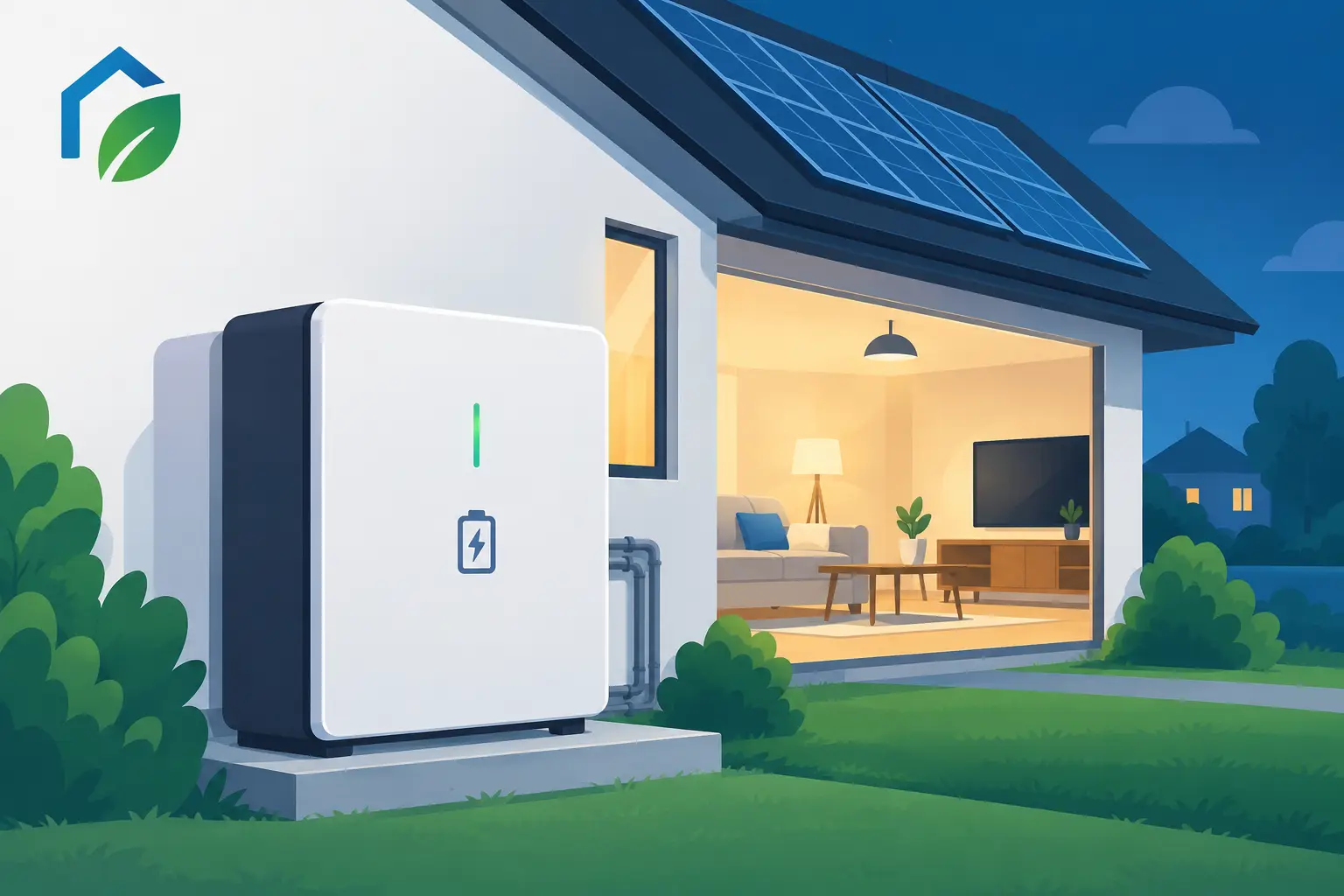
Your smart meter or supplier app can reveal much more than an annual electricity total. Look at what happens after the sun goes down, when solar generation is low and grid electricity is often most expensive. This evening demand is where a battery commonly makes its strongest contribution.
Consider how your household behaves on a normal weekday. Do you cook electrically in the evening? Run a dishwasher overnight? Work from home? Charge an electric vehicle? Use air conditioning, a heat pump or an immersion heater? These loads affect both battery size and the power output you need.
A battery can also be charged from the grid when an off-peak tariff is cheap, then used later when rates are higher. This can improve savings in winter, when solar generation is lower, provided the tariff, battery controls and household usage are all considered together. It is a useful strategy, but it is not a reason to oversize a system without checking the numbers.
Capacity: how long you want stored energy to last
Capacity is best viewed as useful stored energy, rather than a badge of honour. If your household generally uses 7kWh from late afternoon to bedtime, a battery with around 10kWh of usable capacity may cover much of that period on a good day. If you regularly use 15kWh or more overnight, you may need a larger battery bank, altered usage habits, or to accept some grid import.
It is also wise to leave room for real life variation. Winter solar production, cloudy weather, guests, home working and seasonal heating can all change demand. The goal is not necessarily to avoid every unit of grid electricity. It is to reduce costly imports in a way that gives a sound return over the battery’s working life.
Power: what the battery can run at once
Power output becomes especially important in homes with electric showers, induction hobs, kettles, ovens and heat pumps. A 5kW battery may comfortably support lighting, broadband, a fridge, television and several everyday appliances, but a shower or cooker can exceed that on its own.
A good system design sets realistic expectations. You may choose a battery with higher output, manage when certain appliances run, or reserve battery power for essential circuits during an outage. There is no single right approach, only the one that reflects how your home actually operates.
Do you want savings, blackout protection, or both?
This is the question most often missed when comparing home batteries. Many standard solar battery systems stop supplying the property during a grid outage, even when the battery is charged. This is a safety requirement: the system must not send electricity back onto the network while engineers may be working on it.
To keep power available in a cut, the installation needs backup functionality such as an emergency power supply or a dedicated backup gateway. The exact capability varies by equipment and design. Some systems support a limited socket or selected circuits; others can provide wider whole-home backup, subject to the battery power rating and the loads in use.
For most households, backing up essential circuits is the sensible choice. This could include the fridge-freezer, lighting, internet router, selected sockets and, where suitable, heating controls. It avoids draining stored energy quickly on non-essential high-load appliances.
Ask these questions before committing to a battery:
- Will the system provide power during a grid outage?
- Which circuits or appliances will be backed up?
- How quickly will backup power activate?
- Can the battery recharge from solar while the outage continues?
- Are there limits on single-phase or three-phase backup at the property?
A clear answer to each one prevents a disappointing surprise later. Backup is a valuable option, but it adds equipment and design complexity, so it should be specified from the outset.
Match the battery to your solar system and tariff
If you already have solar panels, check whether the proposed battery can be added to your existing inverter or whether an AC-coupled battery is more appropriate. AC-coupled systems can be an effective route for retrofits, while DC-coupled designs are often efficient when solar and battery are installed together. The best option depends on the equipment already in place, roof generation, cable routes and future plans.
If solar is being installed at the same time, designing the panels, inverter and battery as one system usually produces a neater result. It can also make allowances for future expansion, an electric vehicle charger or a heat pump. A battery should not be treated as an afterthought when the rest of the system is being sized.
Tariffs matter too. Intelligent battery controls can charge at cheaper times, preserve capacity for the evening peak and prioritise solar energy when conditions allow. However, tariff savings depend on the difference between cheap and expensive rates, along with round-trip battery losses and any export payments you may receive. A transparent proposal should show assumptions rather than promising a fixed saving that cannot be guaranteed.
Look beyond the headline price
Battery quotations can look similar while including very different levels of functionality. Compare usable capacity rather than total nominal capacity, continuous power output rather than only peak output, warranty terms, backup hardware, monitoring, installation work and any required consumer unit changes.
Warranty wording deserves careful attention. Look for the guaranteed retained capacity or energy throughput, the length of cover, and whether the manufacturer requires internet monitoring or specific installation conditions. A long warranty is reassuring, but responsive aftercare is just as valuable when you need help understanding alerts, settings or performance.
Your installer should also assess the property properly. That includes the incoming supply, consumer unit, earthing arrangement, meter position, network notification requirements and a safe location for the battery. In the UK, equipment selection and installation standards are not details to leave to guesswork.
A battery should fit the life you are planning
The best battery backup is one that still makes sense when your household changes. If you expect to add an electric vehicle, convert a loft, install a heat pump or increase solar generation, modular capacity can be worth considering. If your priority is simply to use more of the solar you already generate, a modest, well-controlled battery may be the better investment.
At Infused Solar Energy, the focus is on designing a system around the property rather than forcing a property around a standard package. A proper survey should give you a clear view of likely generation, storage behaviour, expected savings and exactly what will happen if the grid goes down.
Choose the battery that gives you useful control over your energy every day, not just an impressive specification on paper. When the design matches your usage and future plans, stored solar becomes a practical part of how your home runs.