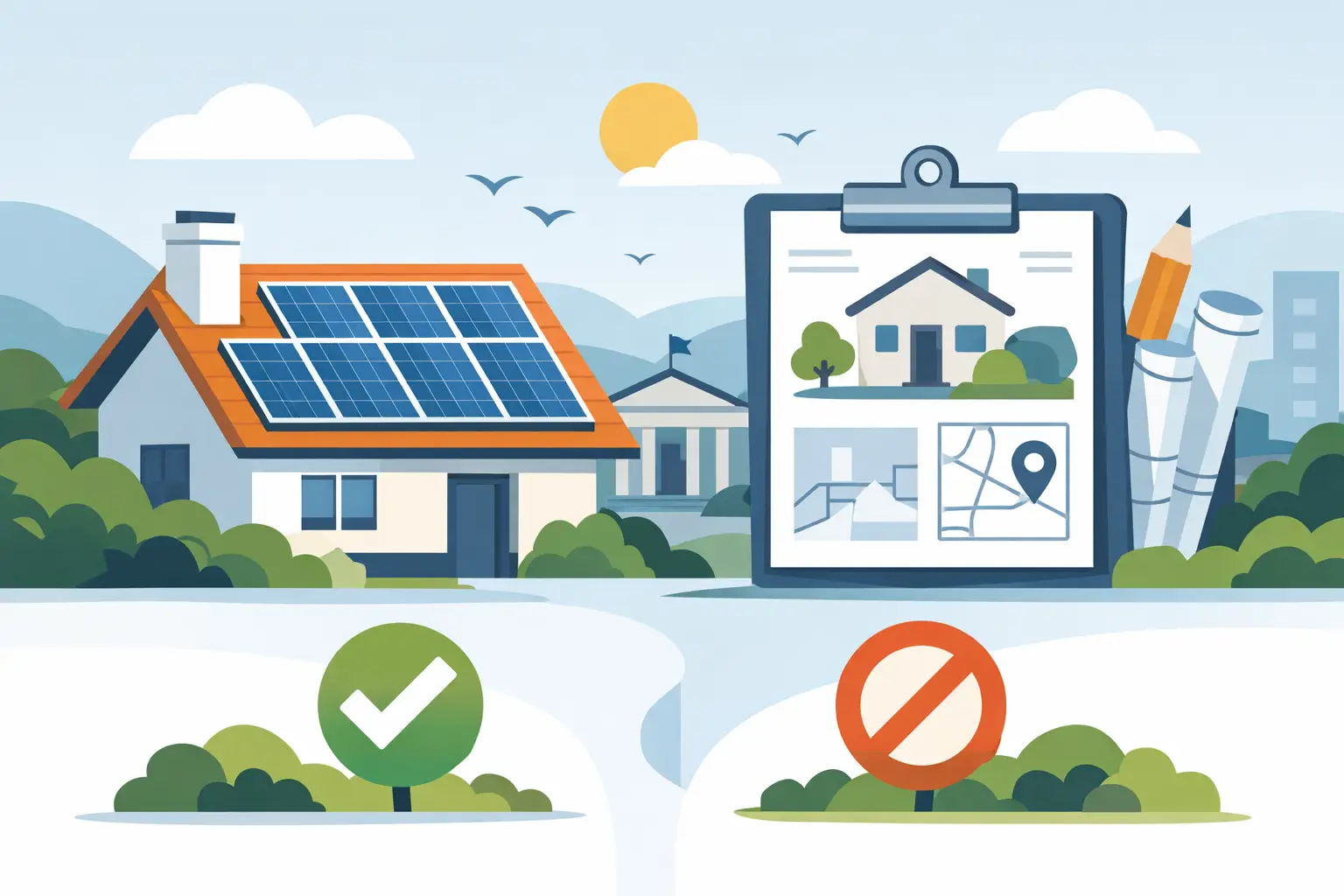
You have found the right roof, worked out the likely savings, and you are ready to make a smart move on your energy bills – then one question stops the process: do solar panels need planning permission? In most cases across the UK, the answer is no. Solar panels are often allowed under permitted development rights, which means you can install them without making a full planning application. That said, there are important exceptions, and getting them wrong can delay your project or create problems later.
For most homeowners, the key is not to assume every property is treated the same. The rules can change depending on where the panels are going, what kind of building you own, and whether your home sits in a protected area. A good installer should help you spot that early, so the process stays straightforward.
Do solar panels need planning permission in the UK?
For a standard house installation, solar panels usually do not need planning permission if they are fitted to the roof and the system does not project excessively from the roof surface. They must also be sited, so far as practical, to minimise the effect on the external appearance of the building and the wider area.
That is the general rule, but there are a few situations where planning permission may be required. If your property is listed, in a conservation area, or the panels are planned for an outbuilding or ground-mounted system, extra checks are often needed. Commercial buildings can also face slightly different planning considerations depending on size, location, and use.
This is why a proper site survey matters. Planning is rarely the biggest barrier to going solar, but it is one of the first things that should be checked properly.
When planning permission is usually not needed
Most domestic rooftop systems fall under permitted development. In practical terms, that means panels can often be installed without a formal planning application, provided basic conditions are met.
For a typical pitched roof, panels should not stick out more than 200mm from the roof slope. They should not be installed above the highest part of the roof, excluding the chimney. On flat roofs, equipment must usually be positioned to keep visual impact down and stay within the relevant height limits.
If you live in a normal residential property outside a protected designation, and the system is being designed sensibly around your roofline, the process is often simpler than people expect. For many homeowners, the planning side is a quick check rather than a major hurdle.
When do solar panels need planning permission?
The answer changes when your property falls into a special category. Listed buildings are the clearest example. If your home is listed, you are far more likely to need listed building consent, and in some cases planning permission as well. That is because alterations that affect the character of the building are more tightly controlled.
Conservation areas can also bring extra scrutiny. Solar panels are not automatically ruled out, but location matters. If panels would be fitted to a wall or roof slope facing a highway and visible from it, the local authority may have stricter requirements. The same applies in places such as Areas of Outstanding Natural Beauty, national parks, or World Heritage Sites, where visual impact can carry more weight.
Ground-mounted solar is another area where rules can change. Small standalone arrays may still be permitted development, but there are limits around size, height, and placement. If the array is larger or closer to boundaries than allowed, permission may be needed.
With commercial properties, planning can be straightforward or more involved depending on the building type and site constraints. Warehouses, farms, offices, schools, and retail units all come with slightly different considerations. Roof structure, visibility, listed status, and local policy can all affect the decision.
The checks that matter before installation
The safest approach is to treat planning as part of the early design stage, not something to revisit once scaffolding is booked. That means looking at the property type, roof orientation, system size, and local authority constraints before the final proposal is signed off.
It is also worth checking whether any previous extensions or alterations have affected your permitted development rights. Some homes, especially newer developments, may have planning conditions attached that remove or restrict those rights. If that has happened, a standard assumption about rooftop solar may no longer apply.
Your installer should also consider building regulations separately from planning permission. These are not the same thing. Even if planning permission is not required, the installation still needs to meet the relevant structural and electrical standards. That includes safe roof loading, compliant electrical work, and proper certification.
For homeowners, that distinction matters. You do not just want panels on the roof. You want a system that is legal, safe, insurable, and designed to perform properly for the long term.
Why the answer is not always a simple yes or no
One of the biggest frustrations for customers is hearing mixed advice. One website says no permission is needed. Another says you should always ask the council. The truth sits in the middle.
For a large number of homes, solar is permitted development and the route is clear. But planning rules are based on context, not just the technology itself. The same set of panels that can be installed freely on one house may need approval on another because of heritage status, site visibility, or a local planning condition.
That is why blanket answers can be unhelpful. Solar is still one of the smartest home investments you can make, but the process works best when it is tailored to the property rather than forced into a generic checklist.
What about battery storage and other solar equipment?
Battery storage itself does not usually trigger planning issues when it is installed inside the property, such as in a garage or utility area. External battery units may need a little more thought, especially if space is tight or visual impact is a concern, but they are generally less likely to raise planning questions than the panels themselves.
Inverters, cabling, and monitoring equipment are usually handled as part of the wider installation design. They still need to comply with technical and safety requirements, but they are not typically the reason a planning issue appears.
That said, every extra element should be considered as part of the overall system layout. A clean design is not just about looks. It helps with compliance, performance, and future maintenance too.
The value of using an installer who checks this properly
A lot of solar delays happen because assumptions were made too early. A homeowner is told it will be fine, then a survey uncovers a planning restriction, roof issue, or paperwork gap that should have been identified from the start.
That is why an end-to-end approach matters. A professional installer should not simply quote for panel numbers and estimated output. They should assess whether the property is suitable, flag any likely planning considerations, explain what is needed in plain English, and build the project around that from day one.
For customers who want solar to feel easy, this is where experience counts. A well-managed installation gives you confidence not only in the system design, but in the process behind it.
A sensible next step if you are unsure
If you are asking do solar panels need planning permission, you are already asking the right question. The next step is not to guess. It is to have your property checked properly before the install is booked.
For many UK homes, the answer will be reassuringly simple. No full planning application, no unnecessary delay, just a clear route to lower electricity bills and more control over your energy use. Where permission or additional consent is needed, it is far better to know early and plan around it than to find out halfway through.
Solar should save you money and reduce hassle, not create it. With the right advice at the start, the path is usually much smoother than it first appears.